
The Letter K | Design, History & Words With K
The letter K plays a unique role in the English language. It’s one of the most uncommon letters in English writing, but it represents indispensable ideas, like “kindness” and “knowledge,” and vivid images, like “kite,” “kangaroo,” and “kaleidoscope.”
While the letter K isn’t common in English words, it’s the 7th most common letter to begin a first name, so it’s common in personalized gifts and décor. Its bold angles and unmistakable silhouette make it especially effective for monograms, wall art, and custom typography.
All of this makes the letter K a fascinating case study for designers, writers, and educators. This guide breaks down the history and anatomy of the letter K, along with the font variations, design ideas, and word choices that will help you use this uncommon letter with confidence.
When you’re ready to get creative, QuillBot’s free image generator can kickstart the process! It can help you visualize design ideas for any letter K project.
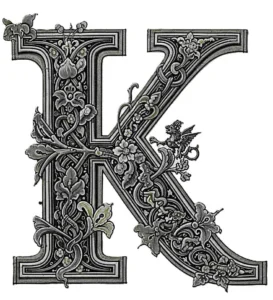
Letter K design from QuillBot’s image generator

Letter K history
Whether you’re crafting a logo, monogram, or custom artwork for your walls, knowing the letter K’s lineage helps you leverage its shape and impact. The timeline also explains why the letter K is uncommon in English words today.
- Phoenecian letter kaph (1050 BCE): The earliest ancestor was the Phoenician letter kaph (𐤊), which represented the “k” sound. The shape was a simple depiction of an open hand.
- Greek kappa (800 BCE): The Greeks adopted kaph as kappa (Κ, κ), preserving the hard “k” sound. They simplified the form into a vertical stem with two diagonal arms, closer to the modern letter K.
- Etruscan and Latin alphabet (700-600 BCE): The Etruscans adopted the Greek kappa and passed it on to the Romans (who created the Latin alphabet), preserving its angular form. In Latin, however, the letter C became the primary way to represent the hard “k” sound. K was retained in the alphabet but used sparingly.
- Old English (5th-11th Century CE): As the Latin alphabet was adapted for Old English, the letter C continued to represent the hard “k” sound (there was no soft C that sounded the same as S). The main use of the letter K was for Greek loanwords or names of Greek origin, like Katherine.
- Middle English (12th-15th Century): After French-speaking people invaded the Anglo-Saxons during the Norman Conquest, many French words became part of the English language. Because the letter C represented the “s” sound in some French words, English scribes began using K for some of the English words that began with C.
- The letter K in English words today: Most English words that begin with the “k” sound start with the letter K (instead of C) if the next letter is I or E. In English, words with the CI or CE combination, the letter C usually represents the “s” sound. First names that begin with the “k” sound can usually begin with K or C (e.g., Katherine/Catherine).
Anatomy of the letter K
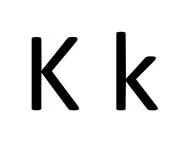
Understanding the anatomy of the letter K helps you manipulate its appearance to match the mood or vibe of a project. Here are the key components of capital and lowercase K to help you design with intention.
- Stem: The vertical stroke that serves as the backbone of capital K and lowercase K
- Arm: The upper diagonal line that extends from the middle of the stem
- Leg: The lower diagonal line
- Counters: The triangular spaces between the stem and arm/leg, which play a huge role in readability and weight
- Ascender (lowercase K): The part of lowercase K that extends above the arm
Capital and lowercase K
Letter K fonts
Whether you’re choosing a font from a library, designing a custom font, or collaborating with a professional designer, there are many ways to display the letter K’s vertical stem and diagonal strokes. Here are some of the many font variations to consider.
- Leg position: The spot where the leg is connected to the stem varies with different fonts. In Calibri, the arm and leg meet at the stem to form one perfect angle. In Arial and other fonts, the leg connects to the arm instead of the stem.
- Counters: The angular spaces between the arms and the stem (aka counters) can be wide or narrow, depending on the font. Wider counters tend to look casual and modern.
- Serif fonts: Serif fonts, like Georgia and Times New Roman, add decorative lines (serifs) to the ends of the stem and arm/leg. The width and placement of serifs also vary across serif typefaces.
- Brackets: Some serif fonts use angled serifs that are called brackets, but others display serifs as straight lines with a uniform weight.
- Stroke contrast: The thickness of the three strokes can be uniform or contrasted, depending on the font. For example, in Verdana, the three strokes of capital K are almost exactly the same thickness. In Georgia, the arm is much thinner than the other strokes.
| Arial |
Kk |
| Calibri |
Kk |
| Georgia |
Kk |
| Helvetica |
Kk |
| Lexend |
Kk |
| Montserrat |
Kk |
| Open Sans |
Kk |
| Roboto |
Kk |
| Times New Roman |
Kk |
| Verdana |
Kk |
- Capital letter K on a white background. The design features a razor-thin, hairline upper arm and a structural, bold lower leg. The counters are expansive and wide, and the serifs are perfectly symmetrical with the vertical and diagonal strokes.
Creative letter K design
Aside from the font variations, there are many ways to design, draw, or display the letter K for creative projects. Options include:
- Images or patterns in the negative space of the letter K for a modern logo
- Floating arm and leg that are slightly separated from the stem
- Calligraphy or cursive K for high-end branding, gifts, and stationery
- Bubble letter K on custom banners, posters, fliers, and children’s decorations
- K-pop inspired letter K with neon colors, sharp angles, and dynamic lighting
- Illuminated letter K featuring intricate gold leaf, floral motifs, or medieval-style illustrations (common in fairy tale anthologies)
- Old English or blackletter K for a traditional aesthetic or dramatic, gothic flair
Words that start with the letter K
Words that start with K can be useful for a variety of letter K-themed projects, from personalized wall art and acrostic poems to marketing slogans and classroom displays. For example you can use these words for alliteration of the “k” sound, word clouds, and more.
- 3-letter words: Keg, key, kid, kin, kit, koi
- 4-letter words: Kale, keel, keen, keep, kept, keys, kick, kill, kiln, kilo, kind, king, kink, kiss, kite, kiwi, knee, knew, knit, knob, knot, know
- 5-letter words: Kaput, karma, kayak, kazoo, kebab, kelly, kendo, Kenya, kiddo, kiosk, kitty, knack, knead, kneel, knick, knife, knock, known, kodak, kooky, kudos
- 6-letter words: Kansas, karate, kennel, kernel, kettle, keypad, kicker, kimchi, kindle, kindly, kitsch, kitten, knight, knotty
- Longer words: Kaleidoscope, kangaroo, karaoke, kerosene, ketchup, keyboard, keynote, kickoff, kilogram, kindergarten, kindred, kinesthetic, kinetic, kingdom, kitchen, knowledge, knuckle
Words that end with K
Words that end with K are perfect for creating visual symmetry (e.g., a headline or title that begins and ends with the same letter) or repeating consonant sounds (aka consonance). Here are some of the many choices.
- 3-letter words: Ark, ask, elk, ink, oak
- 4-letter words: Back, bank, bark, beak, book, buck, bulk, bunk, cork, dank, dark, desk, dock, dork, duck, dunk, dusk, folk, fork, funk, hack, hawk, hook, hunk, junk, kick, lack, lark, lick, link, lock, look, luck, lurk, mark, mask, milk, musk, neck, nook, peak, perk, pink, punk, risk, seek, silk, soak, talk, tank, task, walk, week, work, yolk
- 5-letter words: Black, blank, blink, block, break, brick, brink, brisk, brook, chalk, check, cheek, chunk, clerk, click, clink, clock, creek, drink, flask, fleck, flock, frock, plunk, prank, quick, quirk, shack, shark, shook, sleek, speak, steak, thank, trick, trunk, whisk
- 6-letter words: Embark, hijack, remark, shrink, streak, struck, unlock, unpack
- Longer words: Asterisk, backpack, ballpark, comeback, feedback, flashback, framework, hallmark, hammock, limerick, lipstick, maverick, peacock
Other letters of the alphabet
For details about other letters of the alphabet, check out these articles.
| Letter A | Letter F | Letter L | Letter Q | Letter V |
| Letter B | Letter G | Letter M | Letter R | Letter W |
| Letter C | Letter H | Letter N | Letter S | Letter X |
| Letter D | Letter I | Letter O | Letter T | Letter Y |
| Letter E | Letter J | Letter P | Letter U | Letter Z |
Frequently asked questions about the letter K
- What are some letter K art projects?
-
Here are some ideas for letter K art projects:
- Coloring page of things that start with K (e.g., kangaroo, knight, kazoo, koala, kite)
- Alphabet photography version of a name or word that starts with K (e.g., “Katie”), where the letters are made from found objects and photographed
- Picture frame decoupaged with letter K words from magazines or letter K dictionary pages
Whatever project you’re working on, QuillBot’s free image generator will kickstart the process. Use it to visualize and polish your design ideas before you start creating.
- What are some adjectives starting with K to describe a person?
-
Some adjectives that start with K to describe a person include:
- Keen
- Kind
- Kingly
- Knowledgeable
- Kooky
- Klutzy
- What are some places that start with K?
-
Places that start with K are useful for classroom lessons or custom art projects that focus on the letter K. Some ideas include:
- Kenya
- Korea
- (Mount) Kilimanjaro
- Kalahari Desert
- Kansas City
- Kalamazoo
- Knoxville
- Kawaii
QuillBot’s AI Chat can show you words with the letter K for any theme you can imagine.
Cite this Quillbot article
We encourage the use of reliable sources in all types of writing. You can copy and paste the citation or click the "Cite this article" button to automatically add it to our free Citation Generator.
Routh, N. (2026, January 30). The Letter K | Design, History & Words With K. Quillbot. Retrieved February 4, 2026, from https://quillbot.com/blog/letters/letter-k/